
The decision that looks fine on paper
Say your agency wants another £1,000 a month for ads. The pitch is simple. More money, more leads, more sales.
The spreadsheet agrees. Leads go up by half. Nobody argues with that.
What nobody can see is where the leads go after the form. Suppose your office can call back 60 enquiries a month. Every lead past the 60th sits in an inbox. You paid for it, and nobody rings it.
That is the kind of mistake this article is about. The numbers look fine. The mechanism is hidden.

Four decisions with a machine inside
Here are four.
- Buying more leads when follow-up is the real limit.
- Running a discount that brings more orders but leaves less money.
- Asking buyers to trust a payment hold they cannot picture.
- Shipping a setup flow where new customers stall.
Each one usually gets explained with a paragraph, a spreadsheet or a flowchart. People skim those. Jakob Nielsen's 2008 analysis of web use estimated that people read about 20% of the words on an average page (Nielsen Norman Group).
Trust costs sales too. Baymard Institute surveys US online shoppers about why they leave a checkout. Leaving aside people who were just browsing, 19% said they did not trust the site with their card details (Baymard Institute).
A drawing where the picture and the sums are one thing
Anatomy is a free, open-source skill for AI coding agents, published under the MIT licence (wheresryan22/anatomy on GitHub). You describe an idea. The agent invents a physical object whose working is the idea. Then it builds that object as an interactive drawing on a web page.
One line in the project's description matters most for a business.
Every number the figure shows comes from the same small model that moves its parts.
So the picture cannot disagree with the maths. Move a slider and the drawing and the numbers change together, because one set of sums drives both.
On 14 October I had AI agents build four of these, one for each decision above. Each took 20 to 32 minutes of agent time. A separate AI reviewer, running on a different model, then rebuilt every page and re-ran every check. Here are two of the four.
More leads, same follow-up
The first drawing is a small machine on a bench. Lead cards sit in a hopper and ride a belt. A stacker takes cards up to a stop plate, and the plate is your follow-up capacity. Every card past the plate rides on into an "unanswered" tray.
The inputs are invented, for an invented home improvements firm. It pays £20 a lead. A quarter of the leads it calls back book a consultation. Four in ten consultations buy. Each sale leaves £500 before ad costs.
So every lead that gets called back is worth £50 on average: 25% of 40% of £500. Every lead bought costs £20, called back or not.
Today the firm buys 100 leads and calls back 60. That is 6 sales, or £3,000, minus £2,000 of ads. It keeps £1,000 a month.
Now buy 150 leads. The office still calls back 60. Still 6 sales and £3,000, but the ads now cost £3,000. It keeps £0.
Or keep 100 leads and lift follow-up to 100, say with a part-time call-back assistant at £400 a month. That is 10 sales, or £5,000, minus £2,000 of ads and the £400. It keeps £2,600.
The rule underneath is short. While follow-up has room, each extra lead adds about £30, which is £50 minus £20. Once follow-up is full, each extra lead loses £20.

To redo this for your business you need four numbers. What a lead costs. How many your team can work in a month. What share of worked leads become sales. What one sale leaves you. Past your team's capacity, every extra lead is pure cost.
If follow-up is your limit, I wrote about preparing enquiry replies with AI, with a person checking before anything is sent.
The discount till
The second drawing is a till, cut open. Each order's money drops into four coin lanes: product, fulfilment, returns, and what is left. The height of each stack is the pounds in that lane. A tally on a rail counts the orders.

Again the inputs are invented, this time for an invented homewares shop.
| Before | 20% off, 30% more orders | |
|---|---|---|
| Price | £60 | £48 |
| Costs per order: product £24, fulfilment £6, returns £3 | £33 | £33 |
| Left from each order | £27 | £15 |
| Orders a month | 100 | 130 |
| Left in total (contribution) | £2,700 | £1,950 |
Thirty per cent more orders. £750 less in the till.
Here is the sum to redo with your own margin. Before the discount, each order leaves £27. Twenty per cent off takes £12 off the price, but the costs do not move. So each order now leaves £15.
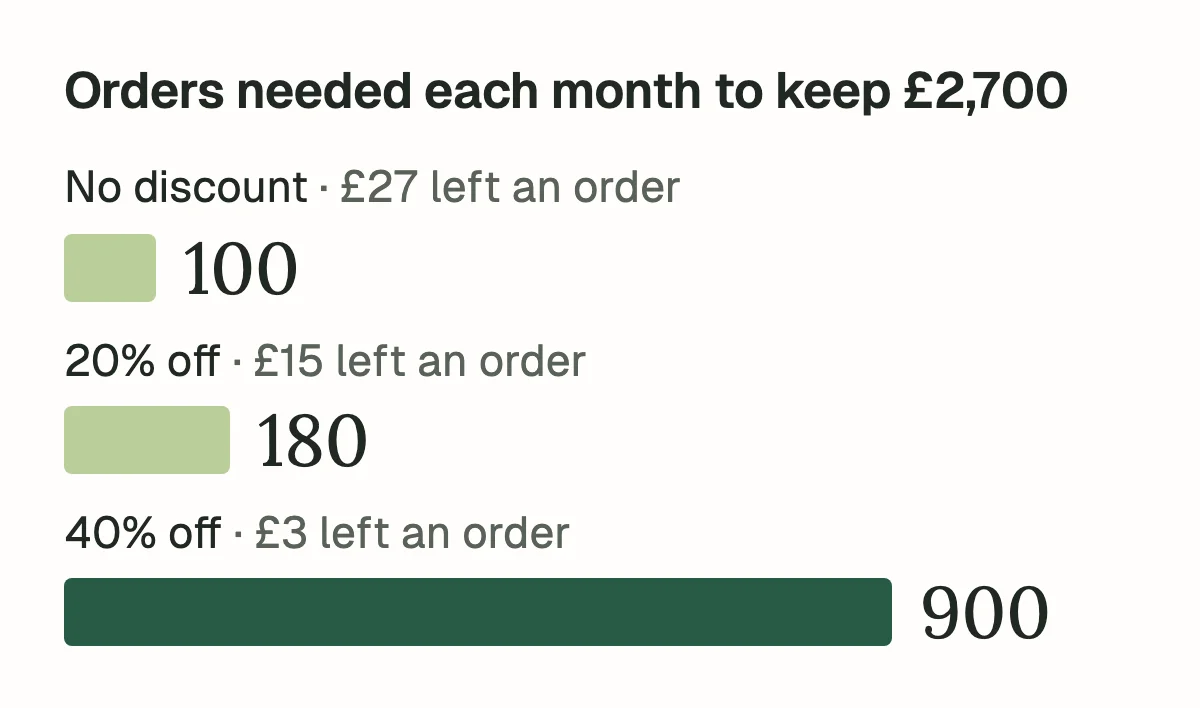
To get back to £2,700 you need £2,700 divided by £15, which is 180 orders. That is 80% more orders just to break even, not 30%.
The general version is one division. Take what an order leaves you today and divide it by what it would leave after the discount. Here that is £27 divided by £15, which is 1.8. You need 1.8 times your orders to stand still.
The thinner the margin left after the discount, the worse it gets. In the same demo, 40% off leaves £3 an order. You would need 900 orders, nine times the starting point.
What the four demos proved, and what they did not
The honest summary is short. The sums are right, and the drawings were quick to build. Whether they help people decide better has not been tested.
Here is what held. Every final model and interface check passed: 74 of 74 for the leads machine, 38 of 38 for the payment hold, 22 of 22 for the setup gates and 12 of 12 for the till. The payment hold's rules held across 54,953 sequences of events, and the till's sums were checked against all 4,141 whole-number pairs of discount and uplift. The reviewer confirmed all four.
| Demo | Checks passed | Used by real people |
|---|---|---|
| Leads machine | 74 of 74 | None |
| Payment hold | 38 of 38 | None |
| Setup gates | 22 of 22 | None |
| Discount till | 12 of 12 | None |
Here is what did not. No real people used any of them.
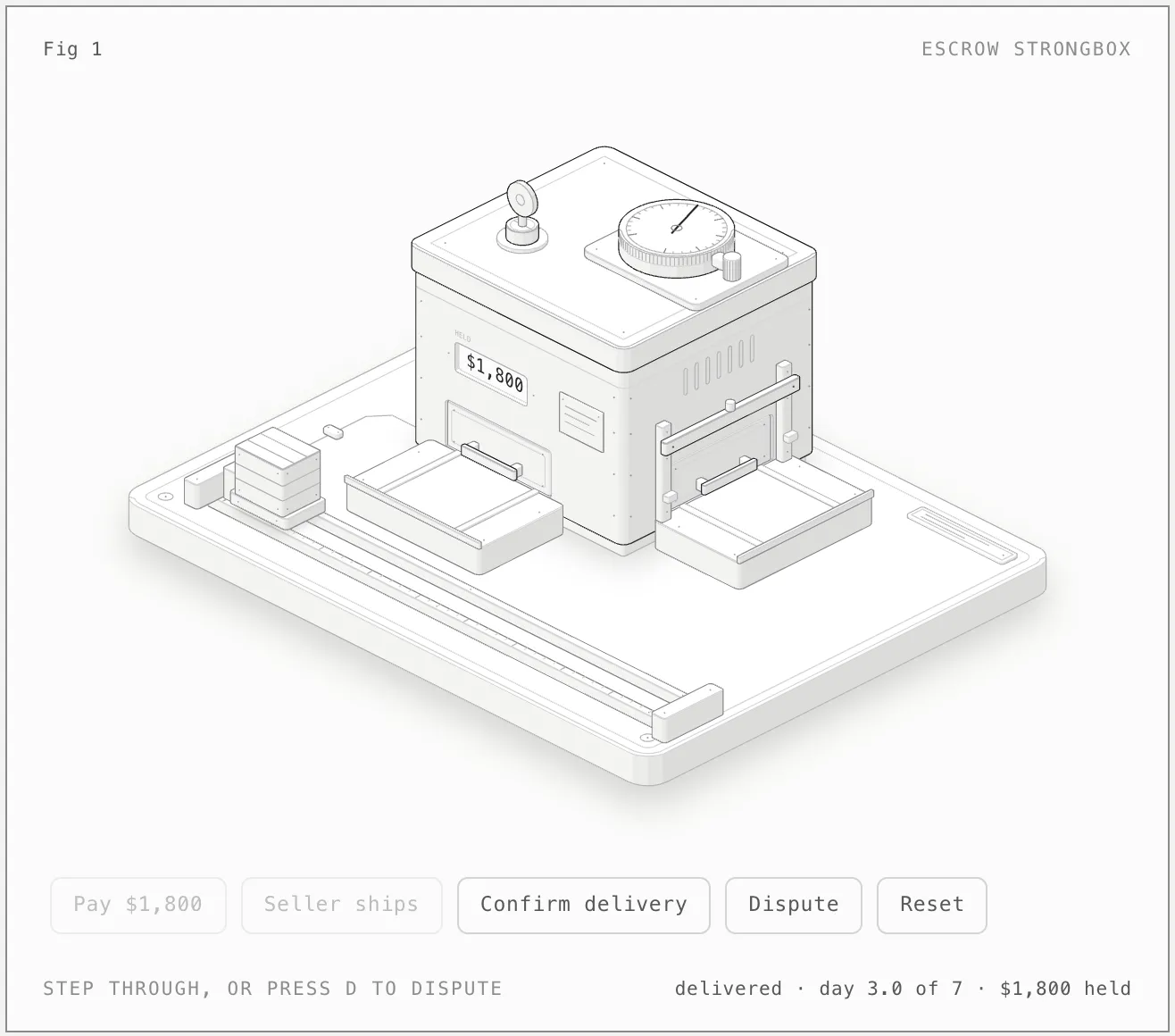
The payment hold was a strongbox for an invented marketplace. It holds the buyer's $1,800 until they confirm delivery, or until 7 days after delivery with no dispute. A dispute freezes it. For a glance test, ten AI agents playing buyers each saw one still image and were asked when the seller gets paid. Nine said after the buyer confirms delivery. But every one of those answers came from the text labels, not the drawing. Only one of the ten even mentioned the 7-day release. And ten agents are one model's opinion, not ten people.
The setup gates showed three steps a new customer must finish before an order creates a job. The target was setup 25% faster than with written instructions. The experiment's own verdict was FAIL. Scripted runs were only about 1% to 3% faster, which is timing noise, and no humans took part.
Other limits matter if you are buying. The style is monochrome, so alarm parts look quiet; the strongbox's dispute bar barely stands out. On the till, the text readouts trail the slider for about three seconds, so you can catch in-between values like "£3,149.99". The strongbox page weighs about 54 KB compressed. That is fine for a checkout, but not tiny. And the project's own page says it draws machines and tools, not people or exact maps. An idea with no mechanism comes out weaker.

Open the exact still they saw, buttons included.
How to try this next week
Pick one decision coming up this quarter where you suspect a hidden mechanism. A campaign. A promotion. A new checkout step. A setup screen customers stall on.
Then gather four things.
- Your own numbers. Margin per sale or per order, cost per lead, conversion rates you have measured. Not the demo's.
- Your capacity. How many enquiries, orders or setups your team can handle in a month.
- Your rules. When money is released. Which steps must be done before an order goes through.
- One question. The decision the drawing must settle, in one sentence.
Hand those to an AI coding agent, such as Claude Code or Codex, with the skill installed. The skill needs Node.js, plus Chrome for its own checks, and no extra packages. Ask for one page, one model, and every assumption labelled on the page. In our runs that took about half an hour of agent time.
Then someone checks the sums before anyone acts on them. That should be the person who owns those numbers, often your finance lead. They redo the three or four headline figures by hand or in a spreadsheet. They try the edges: zero leads, the biggest discount, a dispute on the last day. If a sum is wrong, fix the inputs and rebuild. The drawing is only as true as what you fed it.
To tell whether it helped, run the small test our demos skipped. Write the pass mark down before anyone looks. Show some people the drawing and others a plain sentence or a spreadsheet. If the sentence does as well, use the sentence.
For these four, the tests I would run look like this.
- Eight owners with the leads machine. Can at least six name follow-up as the limit, and say why more leads alone will not help?
- Ten people with the payment hold, five seconds each. Can at least eight say when the seller gets paid? Run a text-only version beside it.
- Five new users on the setup flow, against written instructions. Do at least four finish without help, and is their median time at least 25% shorter?
- Six managers with the till. Do at least five turn down the 20% offer and name the 180 orders?
These are small checks, not research. They tell you whether to keep going. After that, watch the decision itself. Did the money go to follow-up instead of ads? Did the promotion clear its break-even?
Where to start
If a decision like this is on your table, bring it to a free 15-minute call. After the call, we map what the drawing needs with you: the numbers, the rules and who checks them. Then you get a proposal with a custom quote.
You already know which decision keeps getting argued about.
Start with that one.
The Anatomy repository and the research pages above were checked on 14 October 2026. The demo businesses and their numbers are invented.